Africa is home to the world’s youngest and fastest-growing population. Recent analyses underscore that this potential is expanding rapidly: Africa’s working-age population (15-64 years) is expected to double by 2050, accounting for 86% of the total global increase in this age group (OECD, 2024). By 2040, 240 million African youth are expected to have completed upper-secondary or tertiary education, offering a unique opportunity to channel talent into more productive and innovative sectors (OECD, 2024).
Yet Africa’s youth talent pool faces significant challenges. According to the International Labour Organization (2024), 21.9% of youth (53 million) in Sub-Saharan Africa are currently classified as NEET (not in employment, education, or training), with young women particularly affected at 27% compared to 16.9% of young men. A significant number of students exit the education system lacking practical, technical, and digital competencies essential for the modern labour market (OECD, 2024). Despite these challenges, Africa holds vast potential for a sustainable and inclusive future.
Shifting from a traditional education to a holistic Technical and Vocational Skills Development (TVSD) approach is essential. By integrating formal, non-formal, and informal learning, TVSD bridges the gap between theory and the technical skills required for the continent’s green and digital transformations. It ensures education aligns with the demands of the digital economy, emerging energy sectors, and the green transition (McGrath, 2022).
The internationally operating Siemens Stiftung (foundation) advances this approach across Africa through projects that combine hands-on learning, local partnerships and gender-inclusive education. Three compelling examples are WeLearn in Kenya, BeMINT_Nigeria, and Experimento in Ghana, each preparing youth for future-oriented careers in green and digital sectors.
WeLearn – Kenya: Green Skills for a Sustainable Economy
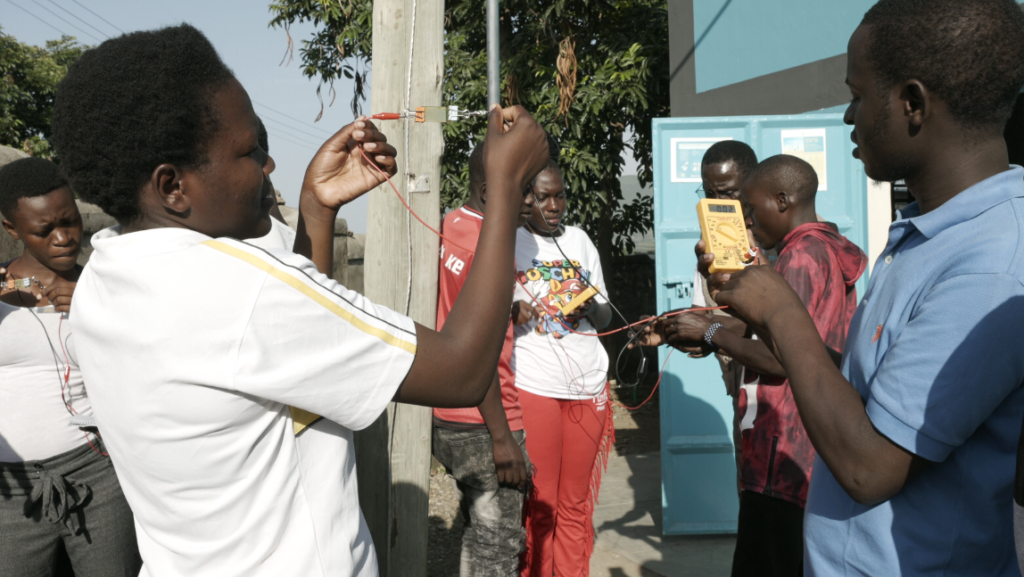
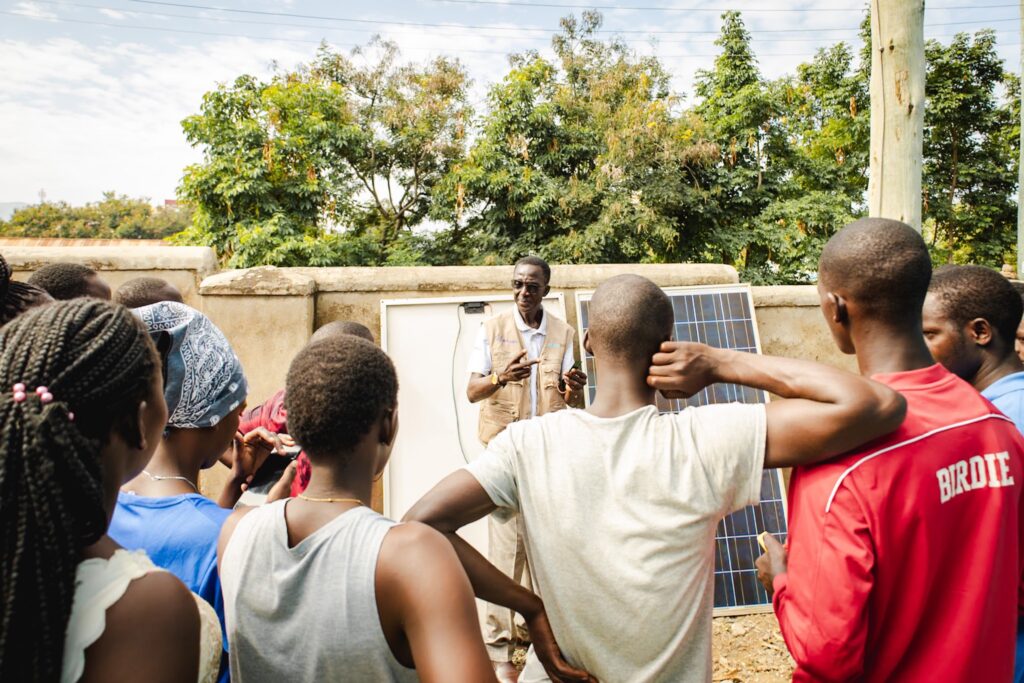
A compelling example of this holistic approach can be seen in Kenya, a country aiming to meet 100% of its energy needs through renewable sources by 2030. To address the growing demand for a skilled workforce in this sector, Siemens Stiftung and the social enterprise WE!Hub Victoria Limited (WeTu) developed the WeLearn project. This five-week vocational orientation programme targets recent high-school graduates in rural communities, specifically in Mbita and Usenge, to spark interest in technical careers within the green economy.
Operating under the motto “Hands on, minds on”, WeLearn uses WeTu’s energy and water hubs as real-world learning laboratories. Participants gain practical experience in areas such as solar panel installation and the operation of e-mobility charging stations. Beyond technical training, the curriculum integrates digital literacy, social entrepreneurship, problem-solving skills, and climate change education.
Jane Akelo, Project Manager for WeLearn explains:
“Part of what we are training is climate change education – so the girls will be able to understand what climate change is and how to mitigate the challenges we’re currently facing in the world.” (YouTube: WeLearn: Empowering Girls in Green Technology)
With a strong commitment to gender parity, targeting 50% female participation, and through the provision of TVET scholarships for further studies at institutions such as Siala TVET College, WeLearn effectively bridges the gap between secondary education and meaningful, future-oriented career pathways in sustainability.
Rebecca Ottmann, who oversees Siemens Stiftung’s education projects in Africa, emphasises:
“WeLearn is all about green workforce development. It gives school graduates vocational orientation towards green technology and careers in environmental protection, providing clear guidance for future opportunities.” (YouTube: WeLearn: Empowering Girls in Green Technology)
BeMINT_Nigeria: Digital Skills for the Future
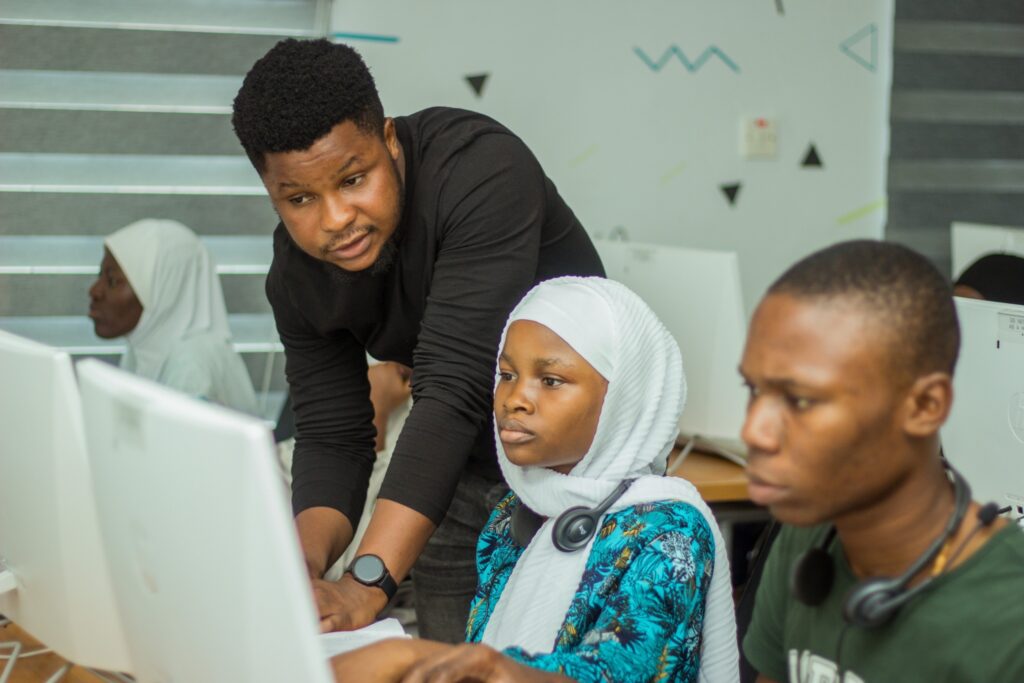
In Nigeria, the BeMINT_Nigeria project equips youth with hands-on digital and STEM skills for the growing tech sector. Funded by the German Federal Ministry for Economic Cooperation and Development (BMZ) and implemented by Siemens Stiftung, the project works with AHK Nigeria (the German Chambers of Commerce Abroad), the NGO Empowering Africans Through Education Initiative (EAE), and the Lagos State Universal Basic Education Board (LASUBEB). A Makerspace serves as a collaborative learning hub where participants turn digital models into physical prototypes using 3D printers, building both technical expertise and problem-solving skills. Graduates receive certifications aligned with German benchmarks, enhancing their employability and competitiveness in the labour market.
Participant reflections:
Samuel Oladimeji: “It opened my mind to see that I had knowledge, and knowledge is power. I was able to see opportunities where people saw problems.” (BeMINT 2.0 Testimonials, 17:40–19:08)
Ukhurebor Anne Ofure: “I had zero knowledge in tech. But coming to BeMINT 2.0 exposed me to skills – soft skills and digital skills. I learned how to use PowerPoint, Canva, and many other tools. BeMINT made me see myself as ‘yes, I can do it.’”
(BeMINT 2.0 Testimonials, 7:53–9:15)
Experimento – Ghana: STEM Careers through Hands-on Learning
In Ghana, the Experimento programme serves as a vital bridge between theoretical STEM subjects and practical career pathways, directly supporting the country’s new competency-based curriculum. Coordinated by the local NGO Experimento Ghana LBG, the initiative provides teachers with specialised training modules to help them link classroom content to concrete professional fields such as mechatronics, electrical engineering, and agriculture.
A key pillar of the programme is the development of 21st-century digital skills through computational thinking and hands-on training with the open-source hardware platform Arduino. By moving away from rigid theoretical instruction toward inquiry-based learning, Experimento prepares the next generation for the demands of the digital economy while empowering learners to translate scientific phenomena into meaningful vocational opportunities.
Empowerment, Social Justice, Coordination and Local Partnerships:
Promoting empowerment and social justice in STEM is a central focus of these projects, particularly in addressing the underrepresentation of women in technical fields. Local trainers and experts serve as role models, demonstrating that technical and entrepreneurial success is possible within their own communities. Local NGOs, such as Empowering Africans Through Education Initiative (EAE) in Nigeria and Experimento Ghana LBG in Ghana, provide knowledge, trust, and hands-on support to ensure programmes are effective and contextually relevant. Where state education services are limited, they ensure projects respond directly to local needs and align with economic opportunities. Rebecca Ottmann leads the projects from Siemens Stiftung, working with organisations such as NGOs, chambers of commerce, and social enterprises to strengthen these local actors, creating a truly community-driven impact.
Conclusion: Empowering Africa’s Youth for a Sustainable Future
The experiences of WeLearn, BeMINT, and Experimento demonstrate that practical, community-driven education is key to unlocking Africa’s demographic potential. By combining technical skills, digital literacy, and entrepreneurial thinking with strong local partnerships, these programmes create meaningful career pathways while promoting social justice and gender equity.
Key takeaways:
- Hands-on learning works: Real-world labs and maker spaces give youth the confidence and skills to thrive in green and digital economies.
- Local partnerships matter: NGOs embedded in their communities ensure programmes are relevant, flexible, and impactful.
- Empowerment drives change: Mentorship, female participation, and role models inspire youth to see themselves as changemakers.
- Holistic education builds futures: Integrating STEM, vocational skills, and entrepreneurial thinking creates opportunities for sustainable development.
With this approach, African youth are not just prepared for the workforce – they are empowered to lead the continent’s transition to a sustainable, inclusive, and innovative future.
Sources:
- AUC/OECD (2024), Africa’s Development Dynamics 2024: Skills, Jobs and Productivity, OECD Publishing, Paris, https://doi.org/10.1787/df06c7a4-en.
- BeMINT_Nigeria – Siemens Stiftung
- International Labour Organization. (2024, August). Global Employment Trends for Youth 2024: Sub-Saharan Africa (Regional brief). https://www.ilo.org/sites/default/files/2024-08/Sub-Saharan%20Africa%20GET%20Youth%202024_0.pdf
- McGrath, S. (2022). Skills futures in Africa. Prospects, 52, 325–341. https://doi.org/10.1007/s11125-022-09622-9
- Vocational orientation in STEM – Siemens Stiftung
- WeLearn – Siemens Stiftung
- WeLearn: Empowering Girls in Green Technology
By Antonia Weinmann, Rebecca Ottmann & Badin Borde (Siemens Stiftung)