
In 1977 I visited this school in a rural part of what was then South Bihar, now Jharkhand in India. The children inside sat quietly on narrow benches, and the proud teacher was delighted to show us around, especially since we were the guests of the civil society organisation that was supporting the school. The children all had bright faces and appeared eager to learn; they were excited about meeting the visitors. That set me on the road to exploring how education in some of the world’s poorest areas could be improved through the involvement of civil society and donors. Over the next 20 years I learnt to apply many of the skills I was gaining, from programming in Fortran in the 1970s and using computers in learning in the mid-1990s, to the university environments in which I was then working. How could these and similar technologies be used to help some of the world’s economically poorest and most marginalised people?
During the early 2000s I was privileged to have been able to put some of what I had learned into practice as leader of the UK Prime Minister’s Imfundo initiative, based within DFID, which created a partnership organisation to use ICTs (as we then called them) to improve education and learning in Africa. We worked in eight countries together with some 40 partners, championed the use of Free and Open-Source Software, sought to introduce thin-client systems into classrooms, tried to prioritise teacher training, and focused our work on marginalised groups such as out-of-school youth and children with disabilities. Above all, we worked with local organisations and government officials, rather than simply introducing bright new tech from the outside in the belief that this would automatically improve learning. Shortly afterwards in 2006, I was honoured to be invited to contribute to the plenary session at the first African eLearning Conference in Addis Ababa, and the grainy video taken by Inge de Waard is still there on YouTube twenty years later!

Fast forward to Tanzania in 2014, and another group of children are learning in a mud hut in a Maasai village (pictured above). Again, they were eager to learn, and colleagues asked a village elder how they might be able to learn from using new digital tech such as mobile phones. But the elder at that time, only just over a decade ago, saw little need. Whereas many more affluent children in the large towns were beginning to use digital tech, the latest technologies were far removed from the realities of rural life there. Across much of Africa the same remains true more than a decade later.
Over the last two decades, the “EdTech Sector” has grown into a global market worth US$199.74 billion in 2025, and is predicted to be worth $456.41 billion by 2030 (Business Research Company, 2026). However, most of Africa’s poorest and most marginalised children remain further and further behind their more privileged peers in other continents. Why is this? Why does it remain so despite the efforts of many well-intentioned people and organisations across Africa and beyond, who care deeply about reducing such inequalities. In part, it is because of a lack of electricity. It remains shocking that 32% of primary and 50% of secondary schools in Africa currently operate off-grid (European Commission, 2025). Without electricity it is impossible to use digital tech (to do good or for harm). However, in part, too, it is a direct result of structural inequalities and vested interests. It is no coincidence that the sector is so often called EdTech. This places the emphasis on the technology rather than the education. More importantly, its name completely ignores actual “learning”, unlike the eLearning Africa conferences held across the continent since 2006. Language matters.
In the second half of the 2020s, the same mistakes are being made in trying to support learning through digital tech that we made more than a quarter of a century ago. Why are we not learning the lessons of the past, despite countless warnings from experienced practitioners? Why do so many new e-learning projects reinvent the wheel, and ultimately increase inequalities rather than reducing them? Why do the UN and international donors persist in promoting the myth that digital tech can deliver on the SDGs and eliminate poverty? Why are so many people so proud of building the plane while flying it? We’ve seen it all before, and the most marginalised communities in Africa (as elsewhere) continue to be left further behind, meaning that the lives of millions of children remain unfulfilled.
I have long pondered on these challenging questions, and my latest book Digital Inclusion in an Unequal World: An Emancipatory Manifesto seeks to answer them. Drawing in part on short vignettes written by 31 contributors, it argues that there are four main reasons why digital tech in general and e-learning in particular are failing the most marginalised: a focus on economic growth rather than equity; a failed UN system which largely serves the interests of Big Tech and the Digital Barons; the me-syndrome, whereby individuals usually seek to roll out technological solutions in their own interests rather than in those of a collective “we”; and an innovation fetish whereby the “new” is frequently seen as being better just by virtue of it being novel. Underlying all of these is the increasing digital enslavement taking place through which we are all losing our freedom and becoming enslaved by the Digital Barons.
Many of the powerful vignettes in the book address educational initiatives in Africa. As Nenna Nwakanma of SwissCognitive comments with respect to the roll-out of digital tech in schools:
When are we going to stop working FOR stakeholders and start working WITH them? Why sit in nice air-conditioned places to make decisions FOR places that have neither basic security nor electricity? How many models exist only for media purposes? We’ve seen it all before: initiatives that are handed down with no intention of making any impact. Digital initiatives FOR that did not start WITH the supposed beneficiaries.
David Hollow of Jigsaw likewise emphasises the key importance of appropriate monitoring, evaluation, research and learning in delivering effective interventions; something that is all too often lacking:
Influencing the detail of how technology is used in education is therefore crucial. The best way to do this effectively is by embedding practical evidence-building – through monitoring, evaluation, research and learning (MERL) – into all aspects of EdTech implementation and associated decision-making. … asking the question can serve as an initial catalyst to build better evidence, ‘raise the bar’ on our expectations of EdTech, and establish greater structural accountability for educational outcomes.
Shabnam Aggarwal takes up these themes, reinforcing the argument that initiatives must focus on the collective “we” rather than “me” if they are to deliver on the learning needs of the poor in a sustainable manner:
We’ve done the ‘Here’s your shiny tool, now off you go!’ routine so many times before. We’ve paraded into schools with tablets and dashboards and overconfidence. We’ve learned the hard way that technology doesn’t empower people. People empower technology. And if the people at the centre – teachers, students, caregivers, school leaders – aren’t part of the act of creation, the tool will eventually gather dust, or quietly erode the very trust and value it was supposed to build.
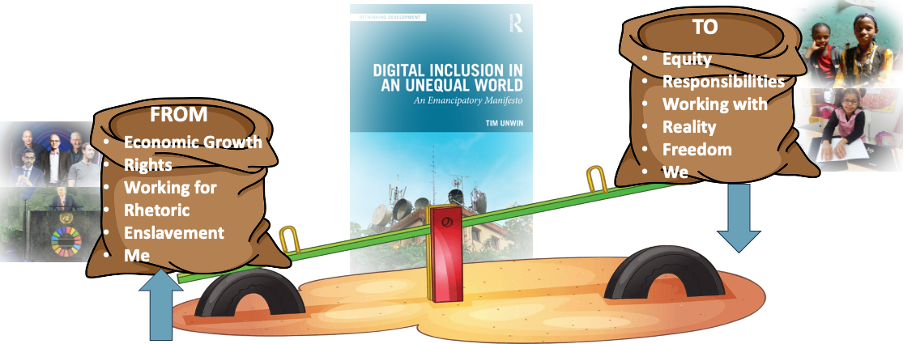
We need to shift the balance away “from” the interests of the rich and powerful and “to” those of the poorest and most marginalised
eLearning Africa continues to provide a valuable forum for sharing experiences, learning from each other, and working together to ensure that digital tech is used wisely and safely by learners across the continent. We all have responsibilities, both personally and professionally, to serve the interests of the poorest and most marginalised, and not just those of the rich and powerful. At a time when governments in many countries are seeking to restrict the undoubtedly harmful use of digital tech by young people, we must seek ways to mitigate these harms so that they can truly gain the benefits of using digital tech for appropriate and effective learning.
By Tim Unwin